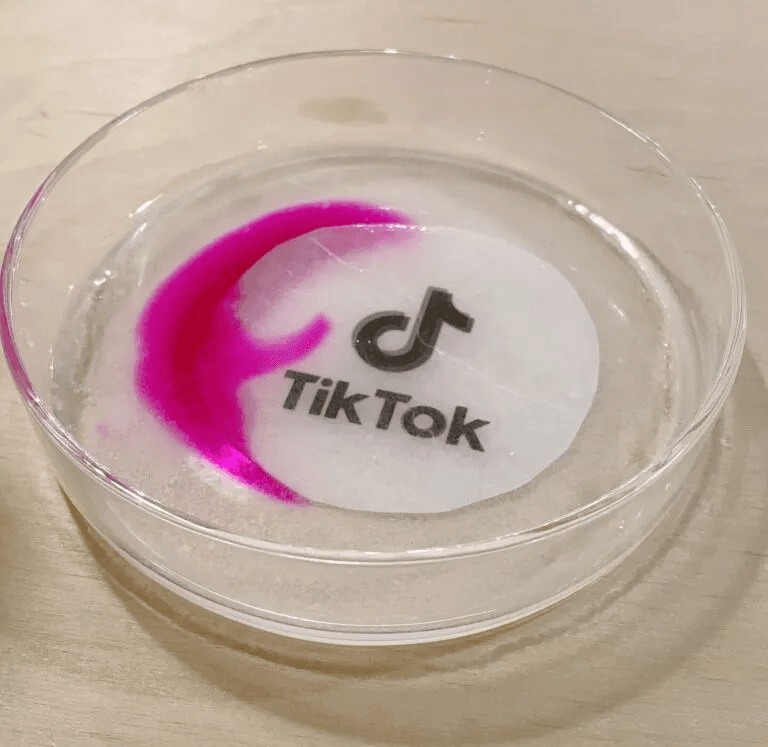
Materializing online commenting through chemical reactions to examine the collective impact of cyberbullying.
Abstract
Comments is a networked installation that visualizes how individual online comments collectively shape the environment of a cyber community. By scanning a QR code and interacting with a web interface, participants can leave either positive or negative comments in a shared virtual space.
These digital actions are translated into a physical chemical process. Basic solutions are dripped into a transparent container with a pH basic solutions are dripped into a transparent container with a pH indicator. As negative comments accumulate, the mixture turns bloody red; positive comments gradually neutralize the solution and restore it to transparency. Through this reaction, abstract online behaviors become visible, material, and cumulative.
In parallel, the system reads out the viewer's IP address and the comment they leave, highlighting the tension between anonymity and responsibility in online spaces.
By combining chemical reactions with artistic expression, Comments frames online commenting as an environmental process rather than an isolated action. The project emphasizes how each comment can alter the shared digital atmosphere, and invites reflection on the harm of cyberbullying and the importance of kindness in contemporary online culture.
Toolkit
javascript, electronics
Exhibition
Expanded Web, 2023
NYU Shanghai, Shanghai, China
Links
Exhibition
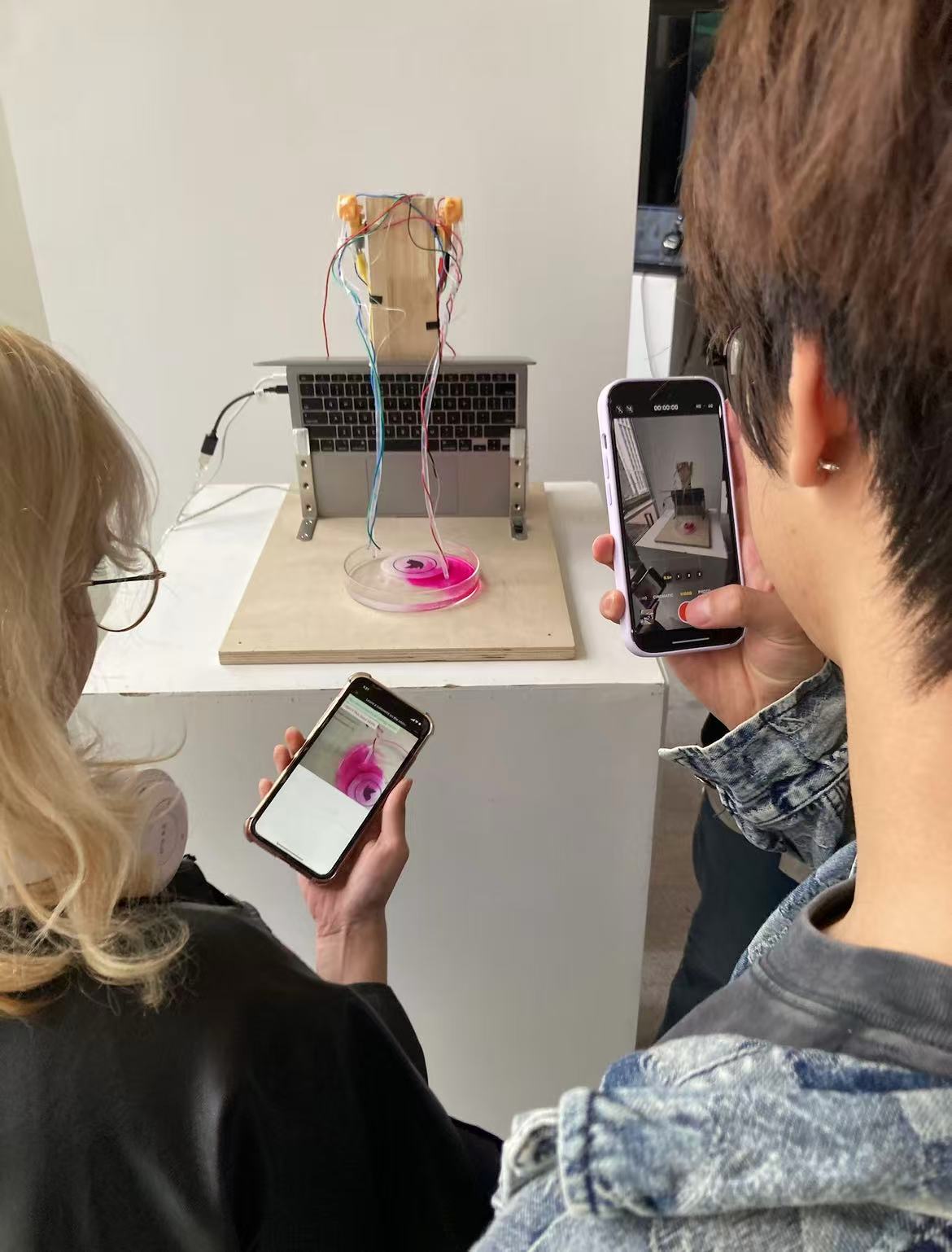
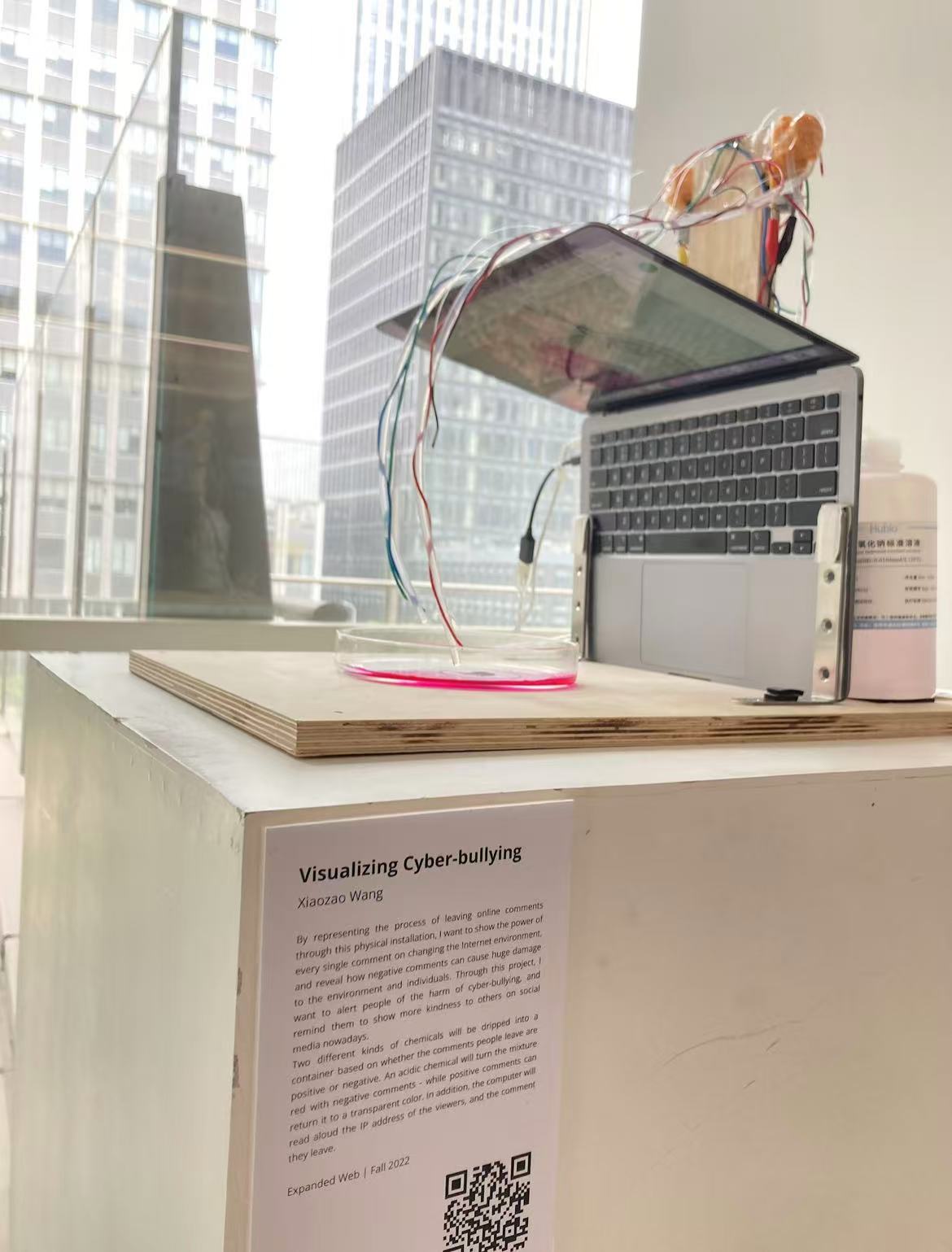
Documentation
Part 1. Motivation and concept
When I was told that project B would be about expanding the web to physical installations, I decided to make some of our actions on the Internet be visible in the physical world, but changing its form. Leaving comments is what we do every day, but people usually only care about expressing their own feelings, but rarely consider others' feelings when receiving negative comments. Saying something harmful online is way easier than in reality. Therefore, I wanted to make a project that visualizes the "commenting" process on the Internet, show the possible impacts of positive and negative comments, and thus encourage people to be responsible for what they say.
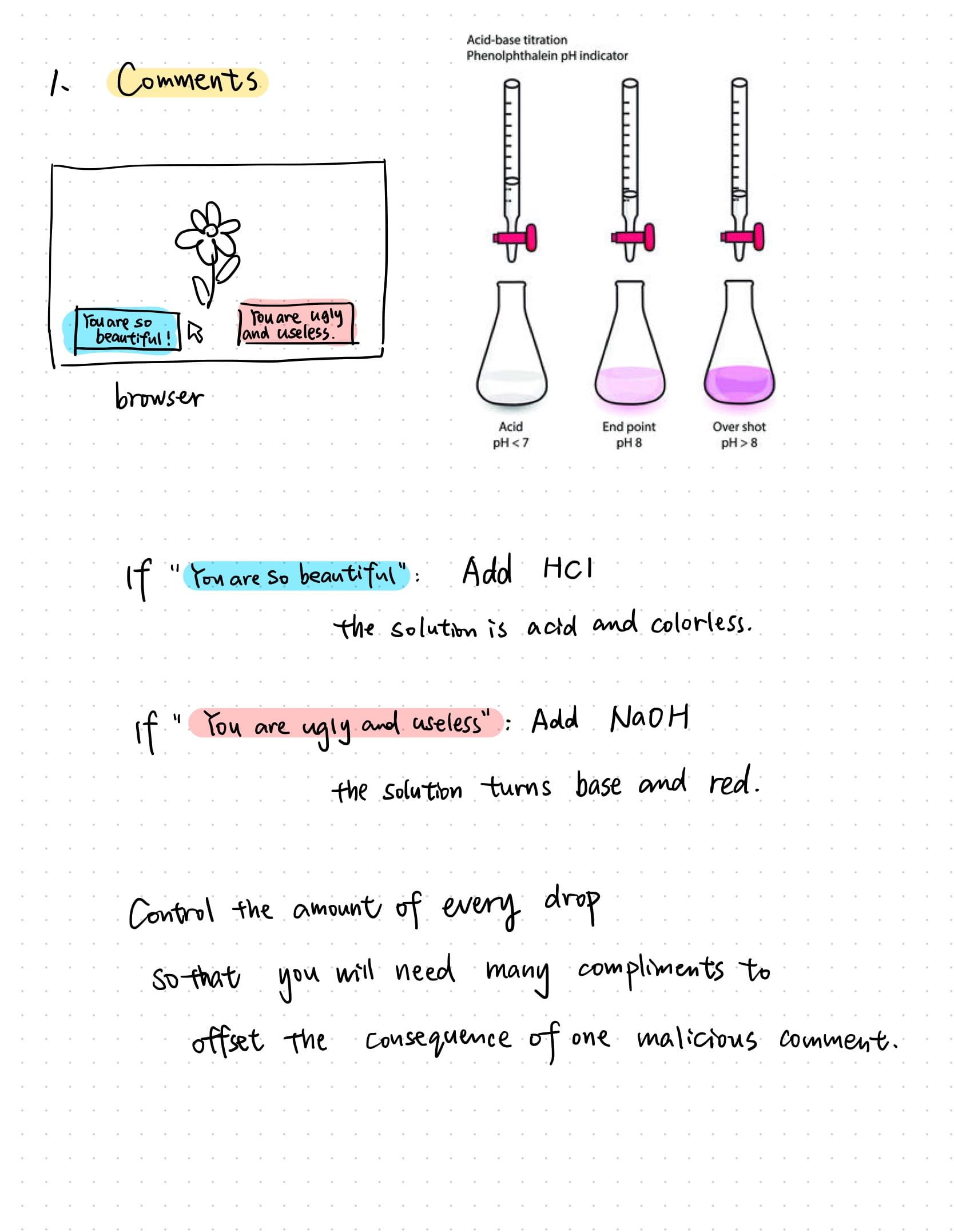
Also, I have learned an experiment in my high school chemistry lab, which uses phenolphthalein as an indicator since it is transparent in an acid environment but turns red in the base environment. Therefore I decided to use HCl and NaOH to control the PH of the solution, and make phenolphthalein change its color and help imply the impact of comments on the social media environment.
This is my draft of the project during brainstorming:
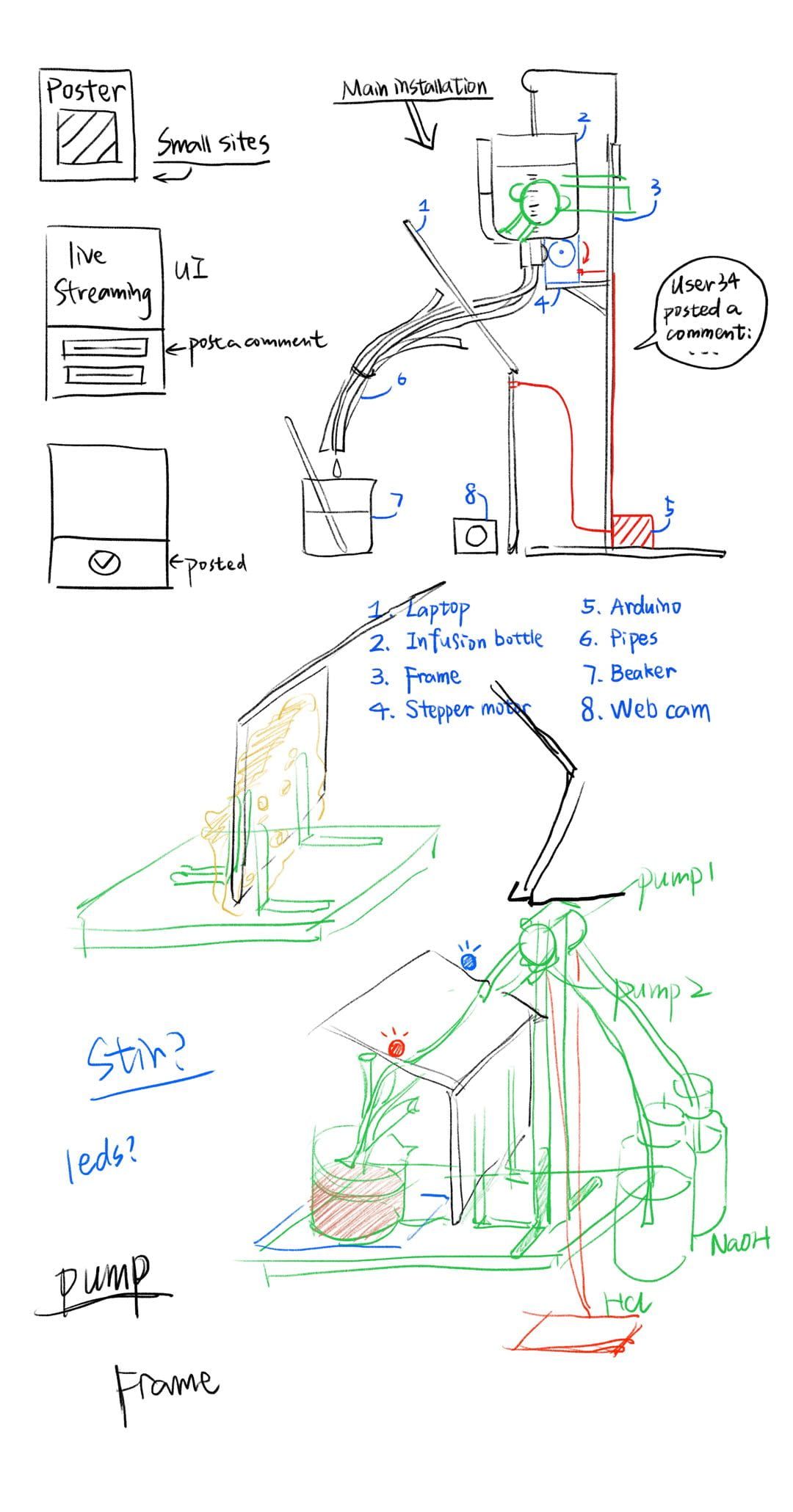
A challenging part is deciding the "proper" comments on my web page for the audience to choose, and the proper image to be stuck to the container representing the receiver of the comments. I tried some woman's images and feminist words at first, I also tried some celebrities' photographs. But in the end, I changed the words to a more generalized and abstract form, and put icons of social media on the container. Maybe that's because I didn't want to focus on a limited area of cyber-bullying, or maybe because I was not brave enough to stand up for a certain group of people?
Part 2. Physical Installation
This part is challenging but also exciting for me. I once thought that I was a person that likes making handicrafts, however, you definitely need to go beyond just doing handicrafts if you want to finish a project on your own. You will need to ask professors and LAs for help, because it's impossible to do everything on your own. You will need to find materials and digital components on your own, which are not provided there at the school, therefore you have to carefully arrange the time to buy them and wait for their arrival. You will need to learn new things such as mixing chemical solutions and wood-cutting, sometimes self-learning is enough, but at most times, asking for help is necessary and more efficient. Asking for help is an important aspect that I learned from this project, though I still didn't do pretty well in it lol.
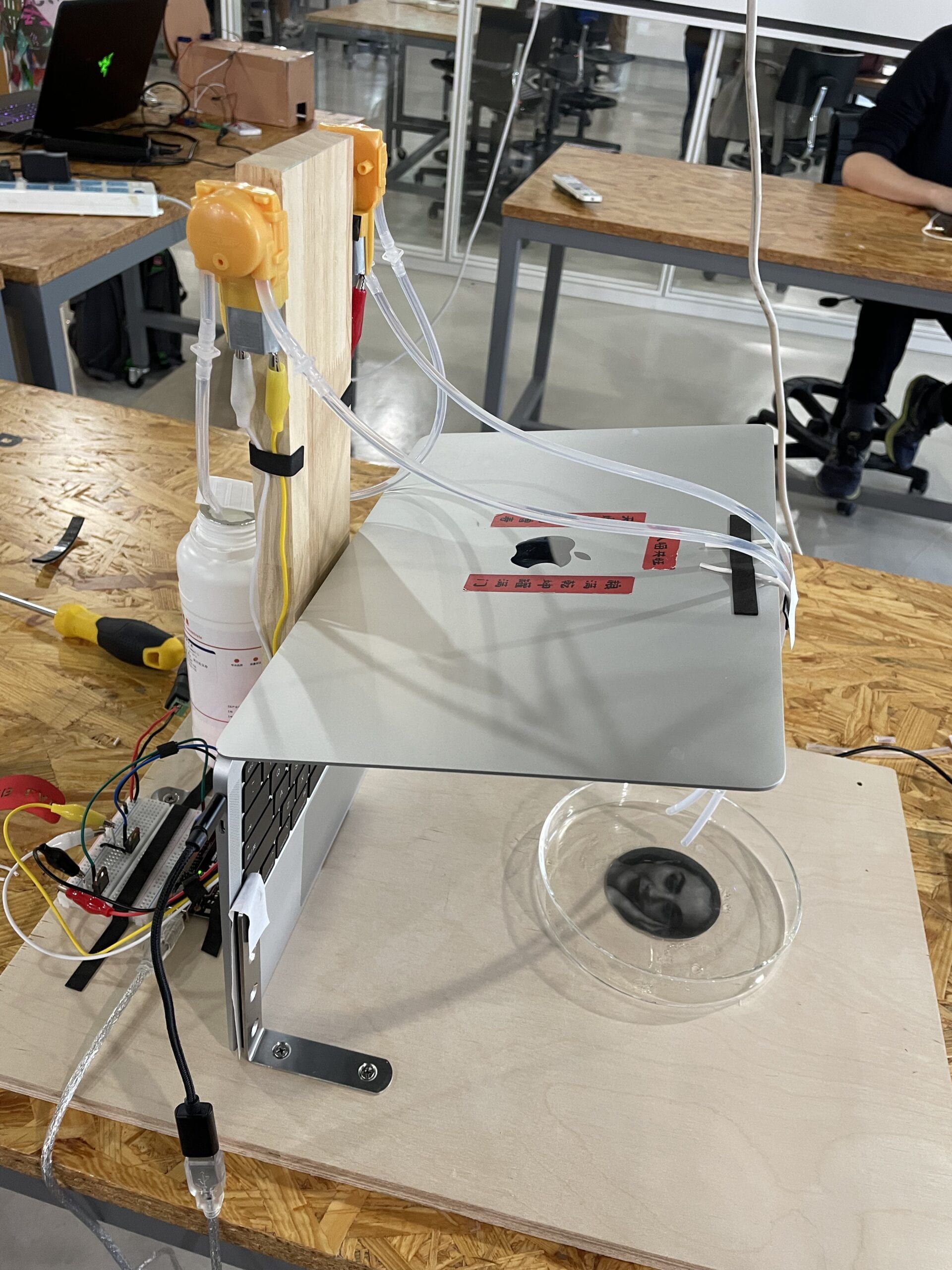
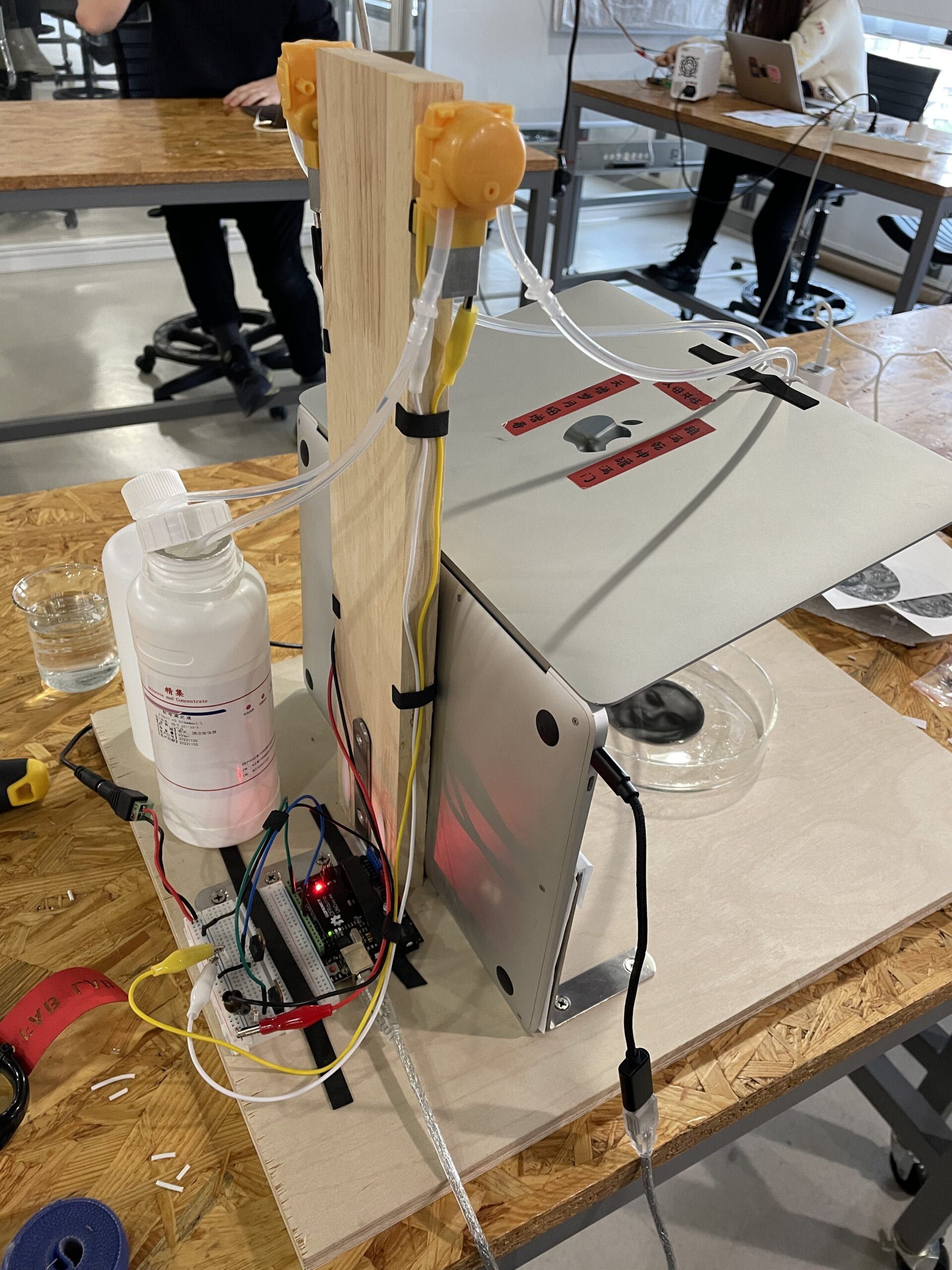
Here is the photo of my physical installation, I make it lab-like, which is inspired by the jellyfish-like exhibit in UCCA edge. I wanted the installation to look like a kind of organism, which shows the dynamic of web space.
Part 3. Web Development
In this part, I mainly applied what we learned about web development in class to the project, including node.js, HTML/CSS, and Arduino. There are two crucial points, one is the design of the user interface, which is basically what they see after scanning the QR code of my webpage. The viewers can see the whole process of mixing the solutions together and changing color through the live streaming on the webpage, and choose to leave a positive or negative comment. They can also see how many positive and negative comments have been sent out in total. The other one is the communication between the front end (HTML and Arduino) and the back end (javascript). Here, I received much help from Gohai, but also, I think I worked hard on exploring and learning on my own!
Part 4. User Tests and Final Project
Here's the video demonstrating how the whole project works:
During the user tests, I received many very insightful and constructive feedbacks:
- Improve the user interface, make the buttons more attractive and make the live stream full screen, which is more comfortable to look at.
- Change the picture inside the container to the icons of social media.
- Generate random comments.
- Encourage the chaos caused by many people leaving comments at the same time.
- Change the paper in the container once in a while, and collect papers with different topics on a big billboard. The color of the paper will reflect people's attitudes towards a certain topic.
I really enjoyed the user testings, especially the last one, the ideas inputted from my colleagues and professors are giving me much imagination on the future improvement of the project!
I think something feasible is point 5 above, and it will be very exciting if I can print more posters containing the QR code and stick them around the campus. I will keep the installation somewhere, and every time a person scans the code and leaves a comment, he/she will contribute to the completion of the project in some way!
Things that can be done better will be doing more preparatory research on cyberbullying and people's behavior in the digital era, which will help me better clarify the concept and goal of my project. I could also work harder on learning HTML, and the overall time management!
Thank you for reading!